13 Factors to Cope with Adult Children’s Rejection and Heal Yourself
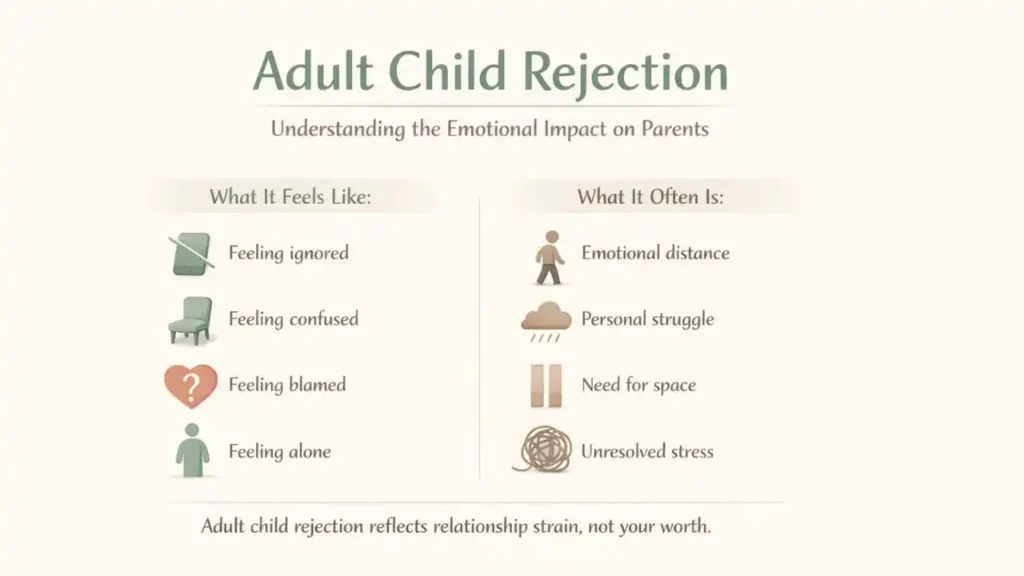
Are you one of those parents who struggles with the pain of being rejected by an adult child and has made efforts to connect with them or make things better but has failed, or things are not working for you. Now, at this point, you’re clueless on how to cope with adult children’s rejection. You are empty from the inside. Every memory feels like hurting yourself.
I can understand what type of thoughts have cluttered your mind, as I have personally dealt with individuals just like you, who are facing the emotions of loneliness, the guilt of not doing enough, and self-doubt, such as you have missed something or it could be done in a better way. You may even question your parenting.
Here we are gonna discuss how to deal with the feeling of being rejected by an adult child and move ahead in your own life peacefully. So, the first thing is acceptance. You can’t control another adult or their life choices, even if they are your own kids. What’s still in your hand is to work on your own self and make your life better. I know, it’s difficult for you, but not impossible.
Table of Contents
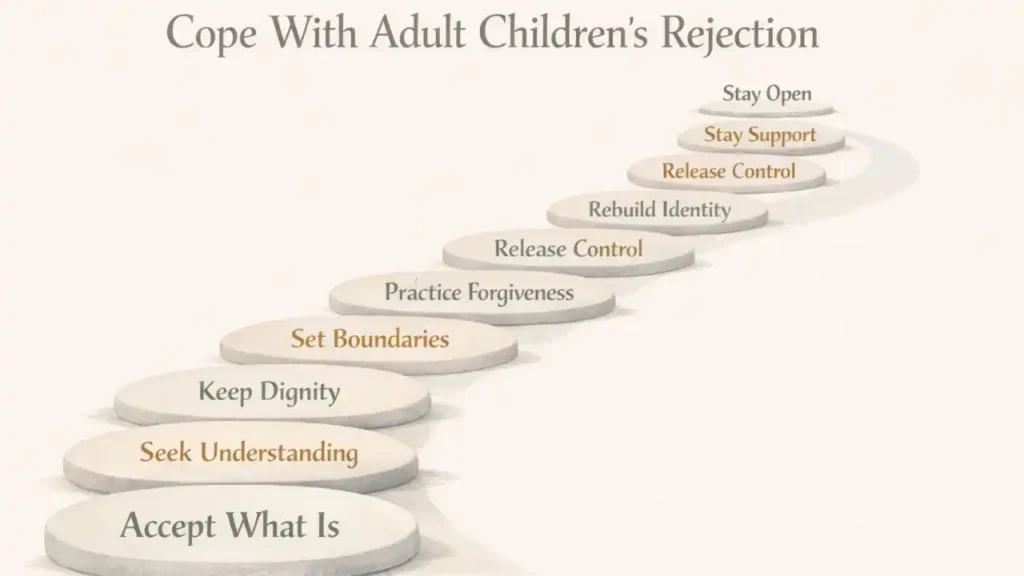
How to Cope with Adult Children’s Rejection and Heal Yourself
1. Accept what’s not in your control
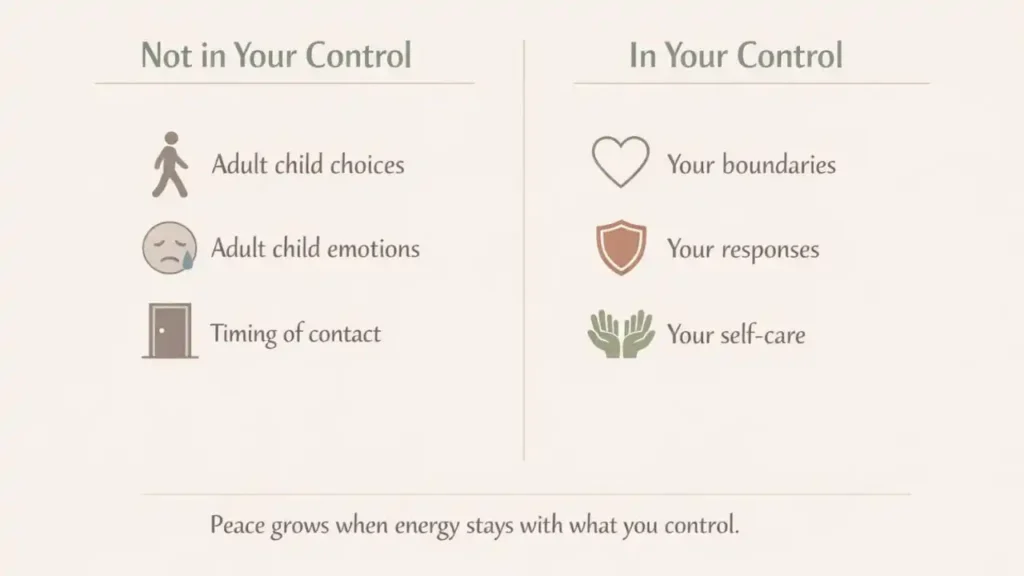
You must accept the reality as it is if you want to heal from the pain of being rejected by an adult child. You can’t change the past, no matter how much it’s hurting, because that’s not in your control. You are just hurting yourself when you repeatedly relive the past memories.
Even if they are your own children, you have to accept that you have no influence over them or their decisions in life and accept that they are now adults with their own beliefs and ways of life.
Stop fighting with your confused thoughts about how it could have been done or what should not, so the situation would be different. With this mindset you won’t be able to heal your wounds because these thoughts will simply push you into uncertainty and self-doubt.
What’s still in your control is how you respond to the situation and handle it. Whether you decide to live in the past, regret what has happened to you, be depressed and uncertain, or accept the situation and move on with your life, focusing on your peace and wellbeing is totally up to you.
2. Understanding rejection as a relational gap, not as a verdict
Rejection doesn’t define your self-worth rather, it is the result of your relationship dynamics with your child. Family psychology study indicates that adult children tend to distance themselves from parents because of emotional barriers, misunderstandings, communication gaps, or unresolved family disputes that built up over time.
Being able to differentiate between your personal identity and your child’s action will help you start work on your mental health to heal yourself. Your adult child’s rejection is their way of how they cope with their own feelings, stress, or uncertainty.
Try to understand their position; they are trying hard to handle their internal conflicts. You might be pulled to define your own value based on your child’s approval. Your personality, your effort, and your values or goals are not a reflection of their response.
This habit may kill the sense of your own self. Your identity existed before you were a parent and still exists. Your parental duties are important, yet they do not entirely determine your worth as an individual.
3. Forgive both you and your adult child.
Forgiveness is not easy for a wounded soul, yet it is the most empowering and the most beneficial act you can do to heal the wounds of adult child rejection.
You start to heal when you no longer allow the pain to control your thoughts and your peace of mind, and let go of the anger or blame. Still, forgiveness does not relieve you from all the wrongs that took place between you and your adult child, but it does reduce the control that anger and resentment have over you. Forgiveness returns you the peace of your heart.
It takes dedication to let go of the disappointment towards your child. It involves making the decision to approach them with kindness and empathy, and not with disappointment.
You’re taking the decision to keep in mind that you both are still learning and evolving, and that’s why self-forgiveness is equally important.
4. Allowing grief without self-judgement
This type of pain is often ignored, so I want to have an honest discussion with you about grief. Even if no one around you acknowledges it, you experienced a true loss. Distance, silence, or a connection that no longer feels stable or warm may all add to the loss. A future that you always imagined with your child but didn’t get may also be the reason for the grief.
You probably noticed that few people express this as grief. Friends may not say anything. The family might change the topic. Lack of support, or sometimes no emotional support, makes you feel lonely or even empty, because the burden is still present there.
I want you to understand that feelings of hopelessness, sadness, confusion, and guilt can all add up to grief. These feelings don’t indicate that you’ve failed. These feelings represent the love, concern, and the close bond you once shared with your child. Your heart breaks because it used to contain something priceless.
You can heal your heart if you address and confront these feelings instead of ignoring or suppressing them. Hidden or suppressed emotions never go away. These emotions often return later as tension, sleeplessness, or unexpected distress. Your openness toward these emotions will make them less powerful.
I suggest that you allow yourself to pass through the pain of adult child rejection with patience and kindness towards your own self. You need to be free to grieve without fear of judgment. You deserve empathy for a grief that is both unspoken and deeply experienced.
5. Reducing self-blame through evidence-based thinking
Sometimes, Self-blame hurts far more than rejection. Your mind might tell you that everything that has gone wrong is just because of you. This point of view is hardly proved by evidence, even when it seems to be valid.
You may believe that a single mistake made by you was the reason for the gap. You may think of earlier conversations again and again in your mind and search for patterns of failure in your connection with your adult child. Every relationship has two sets of limits and emotional needs. Instead of happening all at once, blame usually spreads over time.
Your mind searches for answers while you’re in pain, and self-blame gives you a false sense of control. “If I have done this, I should fix it,” the concept echoes in your mind, but the reality seems to be different. Certain solutions are beyond your reach, no matter how much effort you put in.
I want you to ask a question to yourself, without any judgment or guilt of not doing enough as a parent. “What evidence proves that I am the only one responsible for what has happened?” and seek answers honestly.
You protect your mental health when facts replace fear. Self-respect develops when fairness takes the place of self-blame, and you really deserve that balance to heal those scars.
6. Setting emotional boundaries to protect mental health
If you really want to Cope with Adult Children’s Rejection, then you should set boundaries to protect your own well-being. Maintaining boundaries is about securing your emotional space, but you may confuse it with building walls between you and your children. Setting these boundaries becomes very important for you, especially when it comes to working with older kids.
You may feel the urge to apologize once more, reach out to your adult child, and offer them more of yourself in an attempt to make things better.
I understand; you wish to make things right and repair that relationship, but doing it constantly will only add more to your emotional baggage, and you are already carrying much. At the end, you will feel exhausted, drained of energy, stuck, or stressed.
You don’t have to force yourself too much. Even if taking a step back makes you uncomfortable, it’s okay. This way, you can break the cycle of helplessness, guilt, and anxiety by making space for yourself.
I know it’s difficult for you at first, but placing boundaries will help you regain control over your emotions and protect your mental health.
7. Rebuilding Identity beyond the Parenting Role
I know how deeply your personality is shaped as a parent. Being rejected by an adult child can make you feel like you’ve lost part of yourself. It’s not just about missing them, it’s more about you being unable to practice your identity without this role.
I want you to take a pause and remind yourself who you were before being a parent. You were a complete individual with your own talents, hobbies, expertise, and abilities; you just need to know your worth beyond the role of parenting. At this point in life, as you are in grief, you may need some time to get back in touch with yourself.
You don’t need to wait for your children to return to find purpose in your life. It’s important to understand that your identity may go beyond raising children. You have to find ways of your happiness, whether it’s an employment opportunity, a hobby, or simply taking care of your own wellness; discover what makes you feel contented.
To rediscover your identity doesn’t mean you have to completely forget your role as a parent. It’s about you finding new ways in life to experience and to accept your identity in a different way, and to know your worth as an individual.
8. Seeking Support without Limiting Yourself
I know you find it difficult to seek support, and this is because you are feeling the emotions of guilt and loneliness, or it may be the fear of judgment for being rejected by an adult child. You may try to limit or convince yourself that your problems are irrelevant.
But believe me, reaching out for help is one of the best things you can do for your emotional as well as physical well-being.
Talking to someone, be it a therapist, a support group, or a trusted fellow, or you can join a community can make you feel accepted and heard. Parents who communicate about their emotions in a safe, positive, and supportive environment feel more satisfied and less despair. You are not the only one who has to bear this pain.
9. Be Open to Reconciliation, But Don’t Rush with It
To stay open should not be done forcefully, nor should it be done by putting your self-worth aside. It is more about showing love and compassion without expecting anything in return.
But sometimes when a relationship ends, your first response could be to totally cut the ties. It feels wiser to stand up for yourself, as it appears to be the only option you are left with. But here’s something to consider: even just a little degree of openness makes space for future healing.
If you are having feelings of hurt or guilt, pause before you take any action. Inhale deeply, and then respond to the situation. It’s important to understand that your child could be in distress in ways they can’t even express.
One thing that you must keep in mind is, opening doors for your older child should be done without violating your personal boundaries because they must be protected and maintained, no matter what the situation is or to whom you are dealing with.
10. Maintaining dignity during limited contact or silence
For the sake of your self-respect, you have to maintain your dignity in your connection with your adult kid. According to a family mediation study, maintaining a calm and respectful communication style is essential for family relations. You may want to say everything in one go and escalate the situation.
In an attempt to make things better, you end up making it worse. Unnecessary explanation doesn’t solve the issue; in fact, it just makes you less secure later.
You can apply it in simple way. Respond politely and clearly if you are contacted, and avoid getting emotionally involved to defend yourself. The hope for a better connection in the future can be preserved by maintaining a respectful and polite interaction rather than cutting it off.
11. Let Go of the Need for Control
Parents often feel a need to protect their children, even the adults. In reality, this is not protection but control. Your adult child has become an independent person with their own existence and choice. These choices may also sometimes result in adult child rejection, which makes them distance their relationship with you.
At this point, you should give up on your desire to influence their decisions or choices and provide them the needed space to experience life on their own. By creating this safe space, you will provide mental peace to both you and your child.
Even if your child’s decisions have a big impact on you, you have to accept that you have no control over them. After realizing this, you will set yourself free to recover and to heal from adult child rejection. Take a step back and concentrate on what you can control, such as your own mental and emotional health.
12. Books and Podcasts for Understanding Adult Child Rejection
It can be challenging to find individuals who actually understand you when you’re suffering from adult child rejection. Reading the books and listening to podcasts on what you are going through can give you some guidance and hope to get through the tough times. These resources provide you with knowledge, ways to cope, and above all, a sense of connection.
Book Recommendations
- Rules of Estrangement by Dr. Joshua Coleman.
- Fault Lines: Fractured Families and How to Mend Them by Karl Pillemer Ph.D.
- Reconnecting with Your Estranged Adult Child by Tina Gilbertson.
- Done with Crying by Sheri McGregor
Podcast Recommendations
- The Etrangement Podcast by Dr. Joshua Coleman.
- Reconnection Club Podcast by Tina Gilbertson
13. Look at other possibilities
Before you think of the worst, take a moment to think whether your child has actually rejected you or there is something else going on. Sometimes what seems like adult child rejection is not rejection in reality. Maybe your adult child needs some time to cope with their own challenges.
Your child may be struggling with marital problems, work pressure, psychological issues, or just being exhausted. So, it’s probably that the gap you experience is related to their hidden struggles and has nothing to do with you.
They may want to protect you from their own struggles, or they might be worried about disappointing you, not because they don’t love you, but rather they might feel too overwhelmed to speak up to you.
You can be more kind and less judgmental toward them and yourself when you lessen your assumptions. Sometimes, a change in viewpoint is just what allows healing to take place.
Conclusion
Identity, devotion, and psychological wellness all get damaged when a parent is rejected by adult child. Dealing with adult child rejection does not require deleting love or ignoring your grief. It involves protecting your mental health while respecting your individuality.
You deserve to be heard and accepted. You deserve to be at peace. You deserve self-worth that is above your role of being parent. Healing does not mean to forget your pain. Healing requires recovering one’s integrity, independence, and self-esteem.
You are still valuable even if your relationship seems to be broken.
Why does adult child rejection happen?
Stress, unresolved family disputes, mental health issues, or an urge for independence may all lead the adult children to distance themselves. A distance often indicates a way to cope instead of a lack of love, according to family psychology research. Parental failure or a single cause is rarely the reason behind rejection.
How can parents cope emotionally with adult child rejection?
By separating self-worth from the situation, openly grieving, and setting up emotional boundaries, parents can be more prepared to deal with adult child rejection. According to research, parents who ask for help and stick to their own routines are better able to regain their emotional balance with time.
How long does grief from adult child rejection last?
parent who are rejected by adult children has no time limit to grieve; it’s about how deeply the estrangement has hurt them. Research on prolonged sadness has shown that emotional pain may remain in your heart for years. Healing often begins when parents accept the emotions of their children without putting pressure on them to attain peace or reconcile.
Can adult child estrangement improve over time?
Adult child estrangement can gradually improve, but the results vary. Studies on family reconciliation suggest that connection can be restored when there is less pressure, a respectful distance, and personal recovery. Healing often begins when parents put their own well-being first.
How can I stop blaming myself for adult child rejection?
Self-blame makes mental suffering worse and difficult to heal. Cognitive psychology research shows that challenging your own beliefs reduces anxiety. Parents must understand mutual accountability and the fact that adult children make independent decisions based on a range of factors.