Adult Child Wants No Contact with Parents: 6 Powerful Truths Behind the Painful Silence
“What does it mean when an adult child goes no contact with parents?
When an adult child cuts contact with parents, it means they intentionally reduce or completely stop communication with one or both parents. Psychologists describe this situation as family estrangement, which often develops gradually after years of emotional conflict, boundary tension, or repeated communication breakdown.”
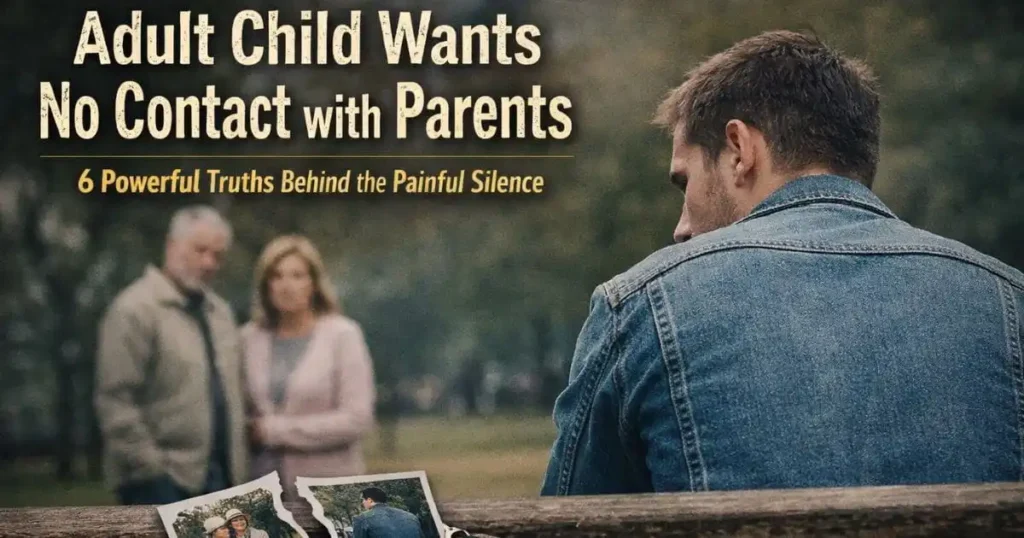
If your adult child refuses to communicate with you, I understand your grief; the pain is not just surface-level, it goes deeper because parents frequently experience mixed feelings of confusion, rejection, and shame. You may constantly ask yourself, “What did I do wrong? What’s my mistake?”
Research from Cornell University sociologist Dr. Karl Pillemer suggests that about 27% of Americans experience estrangement, which shows that family distance affects a significant portion of families in the United States (Pillemer, The Gerontologist).
Learning healthy ways to process these feelings of rejection can help you move forward and begin healing. These factors to cope with adult children’s rejection can provide helpful guidance.
Table of Contents
6 Common Reasons an Adult Child Wants No Contact With Parents
As a parent, you may think of the love you gave to your child or the sacrifices you have made for them, which can be true, but for an adult child, it’s not just about food, education, and safety. They often recall emotional moments when they were ignored or dismissed.
According to sociologist Dr. Karl Pillemer of Cornell University, many adult children who cut contact with their parents report years of feeling dismissed, criticized, or emotionally misunderstood before the relationship finally breaks down. Research on family estrangement shows these separations usually develop gradually through long-term relational conflict rather than one sudden event (Pillemer, The Gerontologist, Oxford Academic).
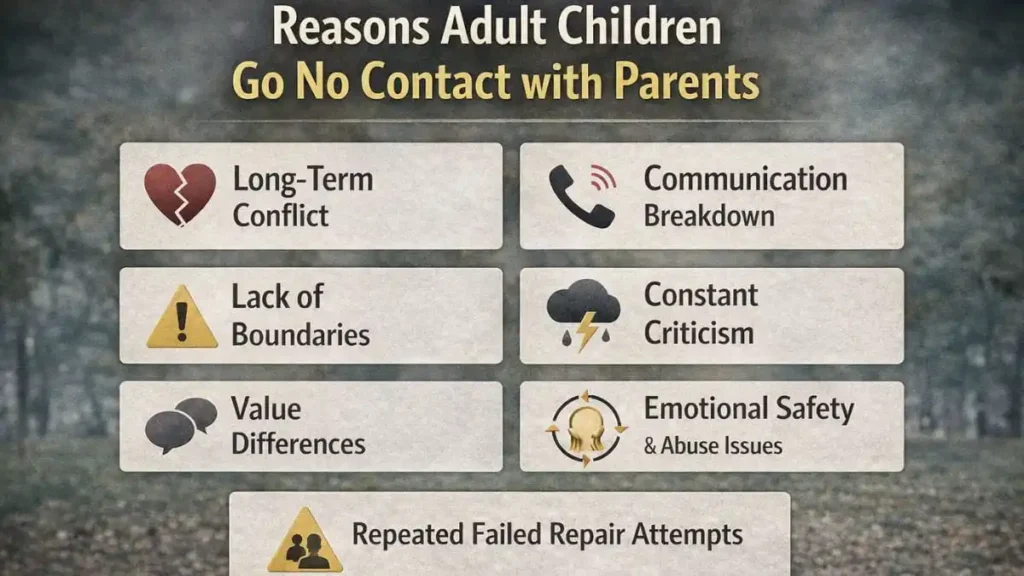
1- When criticism replaces emotional support
Adult children may feel emotionally insecure with their parents if they receive constant criticism or judgment.
As a parent, you may think that you are doing this for your kid’s betterment or to improve them, but when comments about career choices, relationships, or life decisions happen often, the adult child may begin to feel that nothing they do is good enough.
This eventually leads to emotional fatigue. The adult child starts to look for conflict in every interaction rather than feeling supported.
2- When communication turns into repeated conflict
Many estranged families report that their conversations turn into conflicts rather than understanding, and when I notice their patterns, I come to know that they have developed a communication pattern where one side feels unheard.
When this pattern repeats for years, discussions begin to feel pointless, and the adult child can come to the conclusion that distance prevents conflict in the future, and that’s where an adult child refuses to communicate with parents.
So, I came to the conclusion that many families disconnect not because people hate each other, but because communication feels impossible.
3- When life values move in different directions
Differences in beliefs or lifestyle choices can lead to misunderstandings and also create tension in a family.
This often appears in areas such as:
- Marriage decisions
- Spirituality or religion
- Political opinions
- Choices regarding careers
- parenting approach
Parents often see these shifts as a rejection of family values. At the same time, the adult child may feel their personal identity is not accepted or valued, and distance may feel safe to them in order to overcome those repeated emotional battles.
4- When partners or spouses influence family dynamics
When an adult child goes no contact, parents often blame a spouse or partner. In reality, Partners see the family dynamics that adult children accept as normal, and if they find that the relationship is harmful or damaging, then they may push to implement boundaries or distance.
“Partners often highlight the issue; they don’t cause that.”
According to psychologist Dr. Joshua Coleman, a leading researcher on family estrangement, Research shows estrangement usually develops through multiple factors such as unresolved family conflict, mental-health stress, and long-term relational tension rather than one outside influence. (Coleman, Greater Good Science Center, University of California, Berkeley)
5- When emotional safety becomes a priority
I have personally observed in many cases that adult children step away to protect their peace and mental health. In recent years, conversations about mental health have increased. Compared to earlier generations, younger generations prioritize their emotional wellness.
This may not always imply that the parents caused harm on purpose; it means the relationship developed patterns that no longer feel healthy for one side. For this reason, many adult children refuse to communicate with parents.
6- When repeated attempts to fix the relationship fail
After many failed attempts to restore relations, some adult children break ties. Adult children frequently attempt to raise concerns or ask for adjustments in the relationship before estrangement occurs. But they can finally give up if those discussions result in disagreements or rejection.
Psychologists define relationship burnout as the moment at which the emotional effort no longer seems worth the pain.
How to deal with a no-contact adult child?
You may react impatiently or seek an instant fix to the situation when an adult child refuses to communicate with parents, but your pressure can make the situation even worse.
I know it’s difficult, but you need to show patience, respect your child’s boundaries, and give them time. On your side, you can focus on past misunderstandings; even if memories differ, your openness can rebuild your trust and can slowly open the possibility for conversation.
Key insight parents often miss
Parents often focus on intent, while adult children focus more on emotional impact, and that’s where the misunderstanding happens.
As a parent, you may say, “I never meant to hurt you,” and you can be completely true on your side, but your adult child still recalls those emotional moments where they felt neglected or unheard.
Understanding why adult children blame parents for childhood experiences can help you recognize how these emotional memories influence your relationship with your child.
Being a parent, understanding this difference can lead to healthier discussions in the future.
What can parents do today if their adult child wants no contact?
As a parent, you should focus on reflective behavior, fair communication, and emotional tolerance rather than a quick apology or being hasty about reconciliation. Things take time, and if you still want quick fixes, then you may end up annoying or irritating your child.
What you can do now is:
- Write a note that can acknowledge your child’s feelings.
- When speaking, avoid blame or feeling guilty.
- Seek therapy or counseling if emotions become too much to handle on your own.
- Make space for future interaction.
- Protecting your own boundaries is as important as saving your relationship.
What mistakes can push an adult child further away?
I have seen parents often become defensive or completely deny their shortcomings, though you have not done that intentionally, but reactions like these can further push away your child.
When an adult child wants no contact with parents, then statements like “You are too sensitive,” “We did everything for you,” or “You will regret this” may come from hurt, but they make the child feel misunderstood again.
Instead of both parties trying to understand each other, this type of reaction can turn the conversation into a debate, which further grows the emotional gap.
Conclusion
When an adult child wants no contact with parents, the silence can be deeply painful for parents. Sometimes an adult child refuses to communicate with parents because of emotional scars and miscommunications that have built up over many years, not because love or respect has vanished from the relationship.
Parents frequently look for one moment or reason that led to the break, but the real reasons typically develop gradually through continuous disagreement or a sense of being ignored or unheard.
When you face this situation, try not to be defensive; show sincere openness and respect boundaries. While many people suggest quick fixes, in reality, family connections require time, patience, sincerity, and emotional courage to heal.
Key Insights
“When an adult child wants no contact with parents, the decision is usually linked to long-term emotional conflict, repeated communication breakdown, or unresolved boundary struggles. Research on family estrangement shows that distance often develops gradually over time. For many adult children, no contact becomes a way to protect their emotional well-being and personal boundaries.”
Why do adult children go no contact with parents?
When boundaries go unnoticed, communication turns into conflict, or emotional needs are not satisfied, or after years of unsettled conflict, emotional pain, or feeling ignored in a relationship, adult children frequently stop communication.
Why is my adult child so distant?
Sometimes adult children quit contact after a long period of emotional discomfort instead of a single major event. Relationship fatigue can develop over time as a result of continuous disagreement, unfulfilled expectations, or uncomfortable interactions. In such a situation, taking a step back can help an adult child regain their personal identity.
What is the frozen child syndrome?
Frozen child syndrome is a situation in which an adult child completely shuts down in front of parents or avoids any conversation with parents means they don’t express any feelings, nor do they argue with parents, and this usually happens because they feel unsafe in the past.
What is the psychology behind no contact?
The psychology of no contact is protecting one’s emotional boundaries and personal identity. When a relationship repeatedly causes stress, conflict, or emotional pressure, a person may choose distance to regain a sense of safety and control.
How to handle ungrateful adult children?
By setting fair boundaries and avoiding guilt-based arguments, parents may deal with ungrateful adult children. Parents should promote independence while preserving their own mental health rather than expecting praise.
Is it common for adult children to have little or no contact with their parents?
Yes, this is more common than you may think. Research connected to sociologist Dr. Karl Pillemer of Cornell University suggests that about 27% of Americans report being estranged from at least one family member.