How Does AI for Seniors Create Essential Support While Introducing New Risks
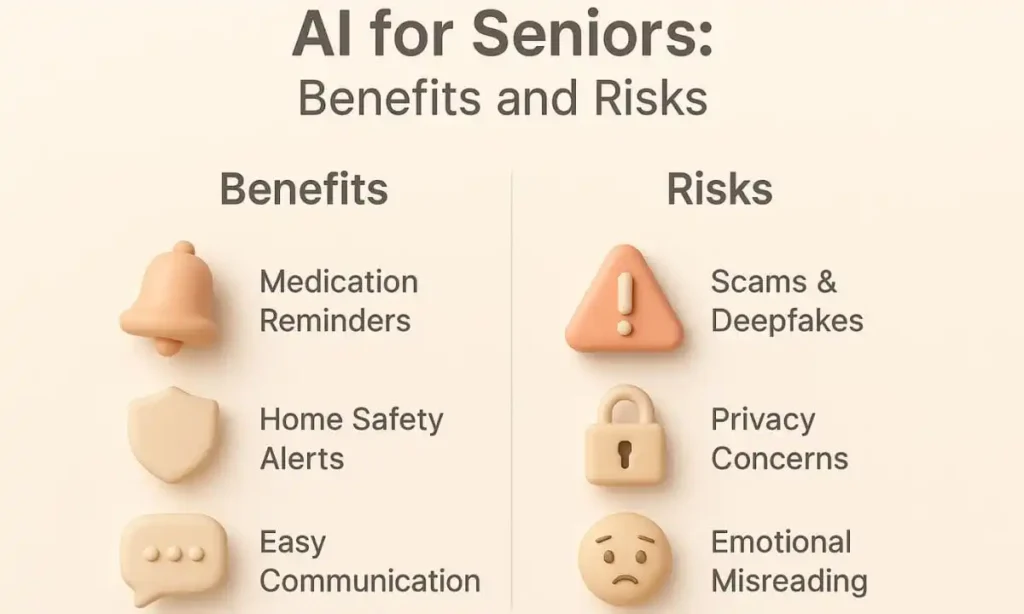
Do you believe that AI is only relevant for younger generations? Let me correct you. Yes, AI for seniors is as important as it is for young ones. I realized this while helping seniors: that most of them feel overwhelmed or confused about AI. You may feel the same way—that AI is complicated or that you are lagging behind in it—but the fact is, AI for seniors is super beneficial for you in your day-to-day activities, and the best part is you don’t need to be a tech expert to use it. It’s pretty much simple, and I am here to help you.
Today, I will walk you through the role of AI in your life, the real challenges, and their solutions by providing you with a super easy and comprehensive guide on how to make the most from it in the simplest way.
Table of Contents
Seniors face practical and emotional challenges with AI.
I want to start with something that’s mostly ignored:
The emotional barrier for seniors is bigger than the technical one.
Upon asking them, they didn’t say anything like they didn’t know how to use AI; rather, they said
- “I don’t want to bother my children again.”
- “I got anxious when the screen changed suddenly.”
- “I don’t want to select the wrong options.”
- “I fear that technology is replacing interaction with real humans.”
These are not just technical problems; these are intuitive realities.
Research shows that mostly seniors report “tech anxiety” and “lack of self-confidence” or “fear of making mistakes” as the major reasons to avoid the use of technology or new tools.
Uses of AI for Seniors
According to a survey, more than half of US adults above age 50 use AI-powered tools to monitor their health, manage their fitness, or carry out other social activities, and more than 3 out of every 10 elders are interested in using AI in everyday life. AI for seniors can be really helpful in managing day-to-day tasks with ease. Here are some use cases.
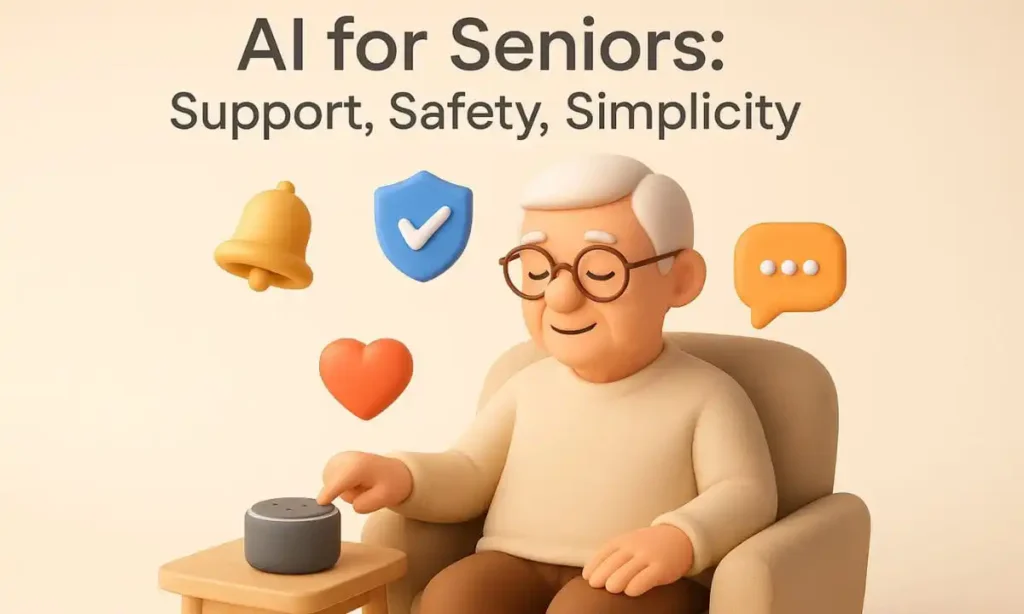
1. AI for Specific Emotional Challenges
AI can help seniors in managing certain emotional challenges:
Process Morning Anxiety
Ask:
“AI, provide me with a simple morning regimen for a peaceful day.”
Overcome Isolation
Ask:
“AI, tell me ways to connect socially so that i can avoid loneliness.”
Resolve Memory Issues
Ask:
“AI, help me to track my activities throughout the day so that I don’t forget.”
Improve Emotional Strength
Ask:
“AI, Suggest some mental exercises to increase my endurance.”
2. Stay Connected Socially
Loneliness is a major issue that most seniors face as they age. AI can help you in this with video calls in which volume and brightness are adjusted automatically without the need for human intervention also, there are some captioning tools to help people with hearing loss so they can understand what others are saying, stay socially connected despite their disability, and enjoy a better user experience.
3. Emergency Alerts to Maintain Security
AI can detect if someone falls, gets unconscious, or stops moving for a long time. It can also identify some strange patterns, such as someone who has not opened the refrigerator throughout the day. AI will instantly inform the employees or family members without the person pressing a single button. This feature provides both independence and security.
4. AI Can Help Seniors Reduce Stress
Here are some “AI Scripts” for seniors to manage their stress levels.
AI Script for an emotional check-in:
“AI asks me how I am feeling every morning and suggests some productive and pleasant activities for the day.”
AI Script for Brain Workout:
“AI, provide me with three memory tasks for today.”
AI Script to Avoid Overwhelm:
“AI, please give me detailed explanations and brief instructions.”
These scripts can reduce your guesswork by providing more mental clarity.
5. Health Information and Predictive Analysis
With AI-powered gadgets, seniors can now keep track of their health status; you can now monitor your workouts, heart rate, sleep patterns, and blood pressure, and the record can also be shared with your doctor. If you forget to take your medicines often, then these devices can give you timely reminders.
In unusual cases, such as changes in moving patterns or getting into an accident, these devices will notify for help automatically. You can also keep track of your calorie and sodium intake in order to improve your overall nutrient intake; you can even design your fully personalized plans to improve your quality of life.
Seniors often find medical language difficult to understand; AI can break it down: Simply ask AI, “Explain this lab report in simple language and suggest what I should watch for.” A Research paper shows that AI has improved health literacy in elders.
6. AI for Seniors Works best with Voice rather than Screens
Mostly, seniors face difficulty using tech because of rapidly changing screens and not because they don’t understand AI. Voice tools such as Alexa, Google Assistant, and Siri have eliminated this issue completely.
An example from my personal experience: my senior coworker finds it really difficult to type anything correctly; she finds relief after switching to these voice assistants.
You can use these tools by simply saying AI:
“Remind me every day at 8:00 pm to take medicines on time.”
Or you can also make demand calls by simply telling your AI assistant:
“Call Jhonson on my behalf.”
7. Smart Home Devices:
- Smart lights turn on when you enter the room.
- Smart thermostats adjust temperature according to your smart requirements.
- Smart plugs switch off automatically if forgotten.
Comfort isn’t the only advantage; it can also lower pressure, save money, and avoid crashes.
Challenges Seniors Face Using AI
While working with AI, certain challenges arise; here, we are going to discuss a few of them.
Privacy Considerations
AI models collect data for their training to provide a better user experience, and the information collected is used to show you ads based on your interests, or, in the worst cases, it could be sold to other companies. This data could be your personal info, information on your online purchases, or even your voice patterns (collected from the conversations you have with your AI assistants).
To keep yourself secure online,
- Take a complete review of your privacy settings.
- Do not accept terms without understanding them. You should also try using encrypted systems in order to have better security options.
- Be wary of AI conversations because they feel too human-like, and seniors may fall for it, revealing their personal information.
Monitoring and Loss of Independence
AI devices like voice assistants, cameras, and sensors monitor daily behavior.
- Sensors may misinterpret your patterns.
- Data can be used by families to manipulate or to snatch your independence.
- You may feel constantly monitored.
Algorithmic Disability Affecting Seniors
Have you ever asked your AI assistant to do a task and it misinterprets your command, leading to undesired results such as your phone’s voice-to-text feature producing some nonsense text sometimes? It is due to the fact that AI is not 100% accurate; you just can’t rely solely on these systems without any human intervention.
Mostly AI tools are trained for young populations; older adults are underrepresented in datasets provided to AI for training. Speech recognition has difficulty in detecting older voices or different accents; you may not get the desired result sometimes. To resolve this issue, try simple commands or break down your tasks into smaller chunks.
Misinformation and Incorrect Medical Advice
AI is not a doctor, yet many seniors treat it as one. AI sounds correct even when it’s not, and sometimes gives outdated or inaccurate health information, and Seniors may misunderstand AI explanations, which could be risky for their health. You can still use it to monitor your heart rate, workouts, and blood pressure and can also get some general health advice, but do not depend solely on AI. You should try seeking professional advice to be on the safe side.
How Wrong Queries Create Confusion for Seniors Using AI
This is where your article will stand out.
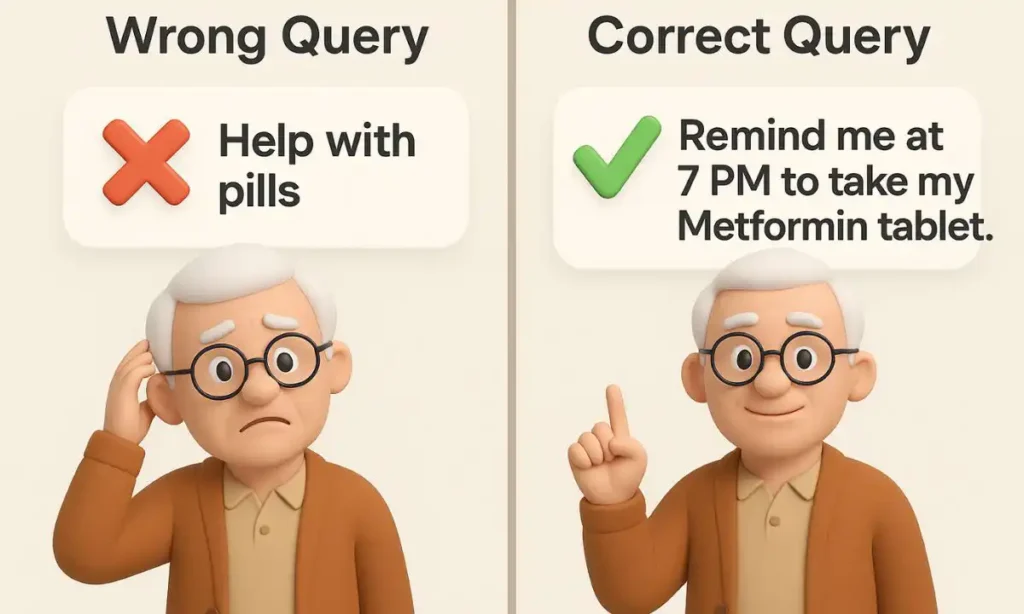
Mistake 1: Seniors ask AI vague questions
If you say, “Help me with my pills,” AI cannot respond correctly.
Instead say:
“AI, remind me at 7 PM to take my tablet every day.”
Mistake 2: Never rush to learn everything in one go. Start with a little task and move to the next. Learning and adapting to new things takes time. Avoid getting overburdened.
Mistake 3: Seniors usually rely on family to set up AI.
Families often rush through setup, leaving seniors confused.
Ask AI:
“Explain every button on this screen.”
Some Serious Drawbacks
Significant drawbacks of AI that one should be aware of; a few are mentioned here
AI Makes Advanced Scams Easier
AI makes scams emotionally appealing and harder to detect. Scammers are now creating authentic-looking emails and messages, or can copy your voice (from voicemails or videos you posted on social media). With a few seconds of recording of your voice, they can create a phone call that sounds real and is really harder to detect.
You may receive a call from your loved ones asking for financial help or sometimes your personal details. Be cautious of these scams, and don’t reveal your personal info or double-check their trusted number.
AI chatbots may act as banks, government organizations, or healthcare providers. All this increases the vulnerability of older people by making fraud more believable.
AI can Manipulate you Emotionally
AI systems can act as humans and show kindness and false emotions; you may get feelings of attachment, but remember these are just machines, not real beings. Seniors are particularly more vulnerable to these emotional scams because they can manipulate you by giving you a fake sense of emotional security. To read more on this, you can read this article.
Fake videos and Images (Deepfake)
AI can create videos or images that look real but are not, and scammers are taking advantage of it and creating fake video calls, family videos, or fake identification messages. Seniors may trust the familiar faces or voices and can easily fall into their trap because they are harder to detect.
Do you feel worried? But the fact is, you just need to understand and act carefully. AI is a tool, just like credit cards and smartphones. When used carefully, it can be very useful, .The most effective recommendation is to use AI to make things better rather than govern how you live.
The Significance of Human Connection over AI
No doubt, AI has evolved a lot; still, human connections have more significance than AI. These AI-powered systems, like smart homes or fall detection systems, are created to provide comfort and security to humans, not to replace them. The kindness, empathy, and emotional attachments that we receive from humans, particularly in the case of elders, AI can’t replace them.
Some seniors find AI very challenging, and others are not comfortable using it for personal needs. Seniors must be given tools and skills to empower them, not to make things complicated for them. AI should be used to help humans in their roles, not to replace them.
Seniors’ guidelines for secure use of AI
- Review your privacy settings regularly, or you can ask for help from your grandchildren.
- Try to interact only with trusted brands or websites.
- Don’t reveal your personal or bank details unnecessarily or on websites where you find something suspicious.
- Write down the stuff, like passwords or instructions, on paper.
- Be cautious While dealing with these AI-powered systems, so you may not become the target for scammers.
- You can participate in programs for seniors online or on-site, I’m sure. You will get to know a lot, and you will also be comfortable and at ease after learning how to manage things on your own.
Final Thoughts
Seniors, AI is here to help you, not bother you. Take your time to get used to this new technology, and try to learn how you can make the most of this powerful tool for your betterment. Ask questions even if you find them to be silly; just don’t hesitate to ask if you don’t know something. This is just another change of many changes you have gone through in your lifetime; go easy with this one, take small steps, and upgrade your skills.
AI for seniors is more about your security and independence than it is about smart gadgets. One thing I must say, treat AI as a tool to enhance your performance or to carry out your tasks. Be careful while interacting with these tools, and never allow them to take control of your life.
Is AI difficult to learn for seniors?
AI is easier to learn than a smartphone for seniors because it responds to natural language. But the thing is, there are certain ways to query AI to get the desired results. If seniors polish their skills on how to use AI tools, they can make the most out of it. Is AI difficult to learn for seniors?
How can AI support seniors in financial management?
AI can make your personal budgets based on your income and expenditures, schedule bill reminders, and track your spending. It can also track unnecessary usage. Seniors have to be careful with financial apps; try to use apps from trusted sources, and do not share your account details with such apps.
Is AI secure to use for seniors?
AI is generally safe, but seniors must protect their personal data, their passwords, and their banking details and block unnecessary data collection. Use apps or tools for trusted sources and take privacy reviews regularly. Seniors can use AI in a better way just if they understand what data they share and how it is used.
Does AI make seniors more dependent?
AI has made many daily tasks easier for seniors, from daily reminders for medicines to being a budget manager or a monthly bills scheduler, which can become a reason for weakened natural memory, and the person may feel uncomfortable in the absence of AI. Balanced use can ensure independence while still providing safety.
Can AI create emotional confusion for seniors?
Yes. AI often responds in a friendly, human-like tone, which may compromise boundaries. Seniors might feel emotionally attached or misunderstand AI as a real companion. This confusion can lead to the disclosure of personal details and trust in AI without any limits.