Midlife Happiness Killers:10 Mistakes that could Steal Your Joy in older age
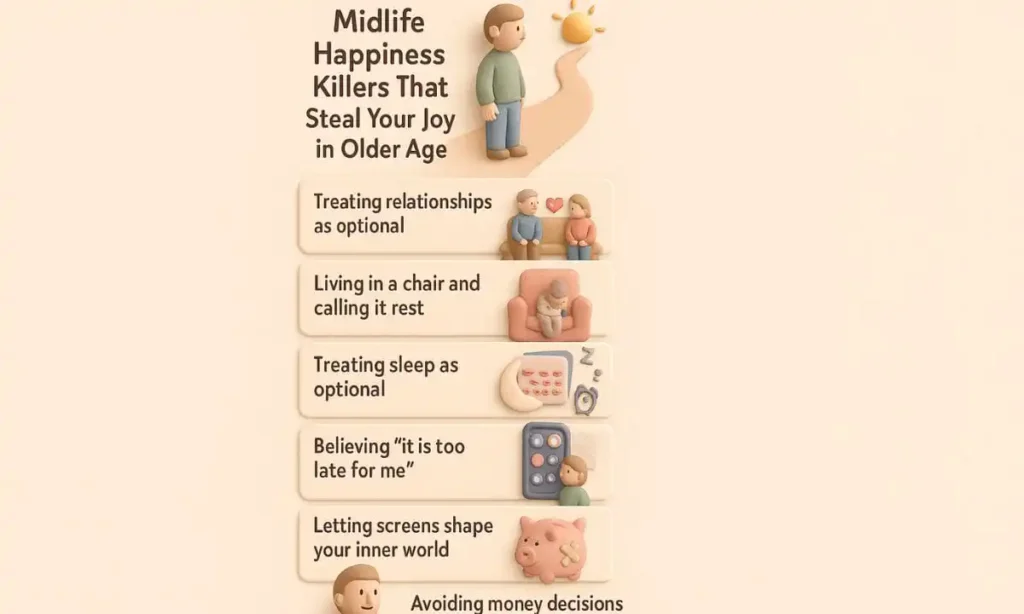
Hey elders! Today, I want to talk about Midlife Happiness Killers with you. I’m not addressing a single midlife mistake. I am referring to the hidden patterns that gradually sap your energy, optimism, and contentment without you acknowledging them. These midlife errors aren’t limited only to your midlife; instead, they will define your old age gradually, like how healthy, happy, and contented you will feel in your 60s, 70s, or beyond.
Researchers who observe contentment in life across multiple countries often observe a U-shaped curve that shows happiness begins to fade in midlife but spikes in later stages of life. From that curve, I got to realize that the choices made in midlife hold the power to push that curve upward or downward for your older self.
Table of Contents
How midlife happiness killers follow you into older age
The pressure of midlife is real. You might be taking care of your own well-being, working life, older parents, and family. This type of pressure often results in reactions that seem like survival strategies.
- In order to save time, you limit or sometimes cut off contact with your friends.
- Lack of energy makes you sit more and perform less.
- You tell yourself you’ll rest later and struggle through the pressure of work.
Experts find significant connections between these trends and future health:
- Isolation from society elevates the chance of death from any reason by no less than 30%, based on detailed meta-analyses of cohort studies.
- Inactivity duration of more than seven to nine hours per day is linked with a higher overall fatality rate, regardless of whether people exercise.
- Work distress or workload has always been linked with higher rates of depression in working individuals, particularly in midlife.
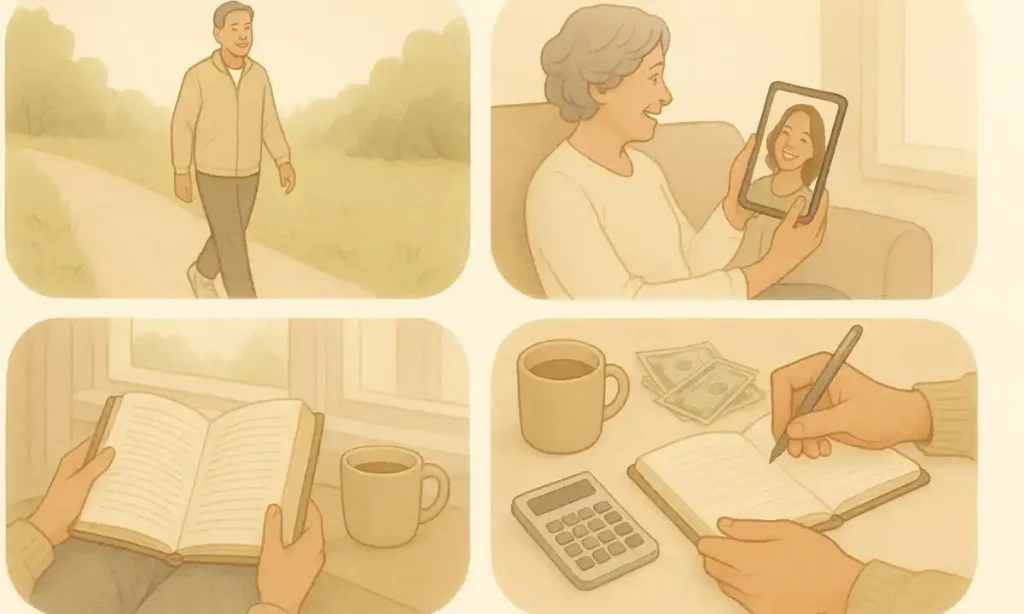
These are not just medical concerns derived from statistics. These are the exact factors that result in aging bodies that have fewer options, limited communication channels, and a feeling that the world is getting harder.
I wish you to think of midlife as the time that builds you for getting older. Any error you made in your midlife either becomes a small contribution to your future happiness or a small cut to it.
10 midlife mistakes that can steal your peace in old age
I’m going to walk you through seven different midlife blunders that ruin midlife joy and explain how they silently rob your future self of happiness. I’ll go over certain steps you may take right now to protect your future years from the negative effects.
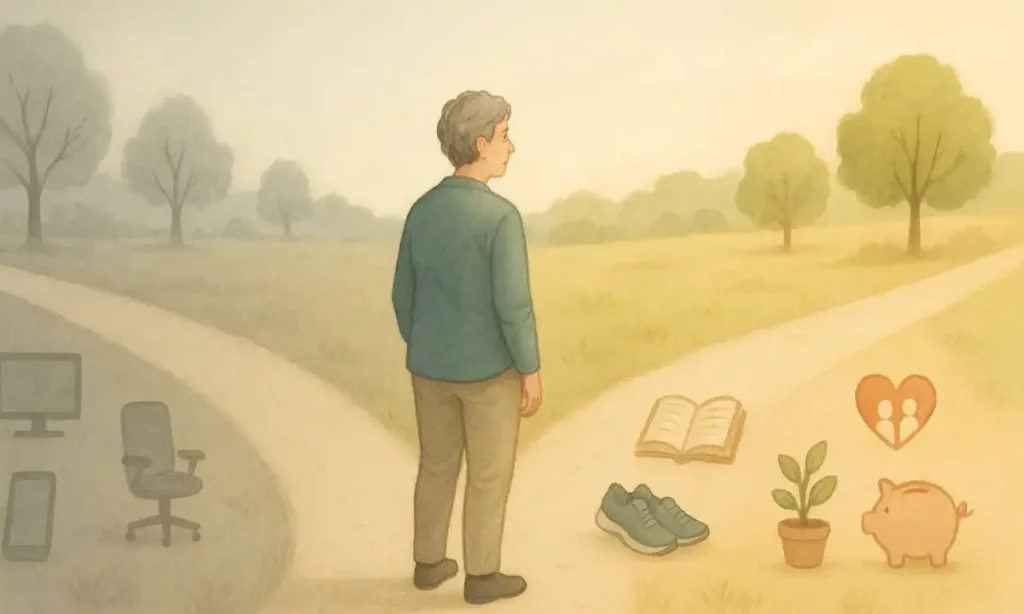
1. Believing “it is too late for me”
That inner voice “My big chances are over.” You may start thinking that your life is now fixed and there is no need for learning or experiencing new things. Then i am here to tell you that “this is not the end.” In fact, with this mindset you will destroy your mental health and will lead to a meaningless and stagnant life.
It is observed that older individuals show more positive emotions and better emotional regulation than the young adults. this proves that your older self is capable of exploring and enjoying new things like new skills, careers, and interests that would keep you sharp. Now, keep aside that old perspective, “it’s too late now,” and do something for yourself. So, when you look back at your life 15 years later, you will not regret that you didn’t even try.
2. They stop gratitude and focus more on regrets
People stop practicing gratitude and focus more on past regrets. Many of us were not able to do everything we wanted to do in life, but that doesn’t mean you have not done anything; in fact, you may have experienced adventures of life that many people dreamt of. your only focus is about the image that you once created of yourself or how you wanted to run your life, like “what you should have accomplished by this time” or “what type of experiences you could have had,” but somehow you didn’t get to do that.
With this thinking approach, you are only punishing your emotional self, which would only take away contentment from your life. Now, you should start practicing gratitude by shifting your focus towards “what fair accomplishments has life given you?” or “what other opportunities have you gotten?” Even in your 60s or 70s, there is much more to be grateful for, like your connections, memories, wisdom, dignity, individuality, and even more if you focus on it. Gratitude attracts abundance.
3. Holding on to past grudges
Everyone has bitter memories from their past by the time they are in their seventies, including failed marriages, unsettled family disputes, and ongoing dissatisfaction.
Research on emotional aging shows an appealing observation: older persons who let go of past animosity have far greater concentration and lower levels of stress and mental health, as well as physical health, than those who hold on to it.
You are not secured by concerns. They simply preserve your emotional connection to the past.
Letting go of what happened doesn’t mean what happened was okay. It actually means releasing the burden that your soul has been carrying for so long.
Your 70s shouldn’t leave you overburdened by grudges from past events.
4. Avoid Money Decisions and Leave Your Future Self Unprotected
Worries about finances often sit in the background of midlife. Every single time a bill shows up or anybody talks about your retirement, you feel that fear, even if you are hesitant to acknowledge it. I observe a lot of people managing this by avoiding opening statements, neglecting to compile those facts and figures, and convincing themselves that “something will work out,” but that need to take financial decisions does not disappear when you do that; it’s still there and will be even in your 60s, but if you do not take this much-needed step It develop a pressure that follows you till your older age.
I want you to understand the expense that silence is for your elder self. Ignoring problems for long may lead you into labor when your body deserves rest. You might be left with fewer possibilities for where you stay and how you are taken care of as a consequence. This stillness has a tendency to turn each unexpected expense into an unexpected crisis that drains you of your compassion, peace, and sleep. Even if avoidance seems to be less complicated now, it will gradually weaken your independence and security in the coming years.
5. You are still living in “I used to be…” instead of “I am.”
Many people in their midlife get trapped in their past identities; all they think about is how they used to be, their job status, their reputation, and some other achievements, staying in the past all the time gradually makes them dull, which then leads to frustration and being resistant to change.
Instead, they should focus more on who they have become now. Humans change with time; life gives us new opportunities or identities, and this is what we call “transition.” This provides us with the room to work on ourselves, to evolve with the times, and to experience new things or some other beautiful aspects of life that we were unaware of before.
By staying in the past, they are giving their mind a clear message that the good days are gone; this approach will drain their energy and fulfillment from later stages of their life.
6. You Push Your Happiness to the Bottom of the List
You are well aware of your happiness, like reading that book, writing a journal, walking in nature while humming, art, cooking just for fun, learning a skill, or experiencing some new adventures, but the fact is you have pushed all this to the bottom of your to-do list in order to fulfill the responsibilities that life brings your way. While managing the other aspects of life, you just forget your own self, and honestly, it’s going to be very expensive if things continue to work this way.
Spare some time for yourself; do whatever you want to, like go on that trip or that long drive that you were constantly putting on hold, or spend time observing nature, and try to reflect on your own self. I know it would be hard for you at the start, but trust me, your emotional as well as physical self needs this the most; they are craving it and shouldn’t be neglected anymore, and if they remain forgotten, you will end up as a resentful and discontented being in the later stages of life, making your life hell on your own.
7. You Avoid Technology and Make Your Future Self Dependent
Many people as they grow older in age stop or limit their use of technology out of fear or furstration like what if i did something wrong, or this doesn’t belong to me now.” they stop using apps and online services, at first this avoidance feels easy, but with time it limits their future independence and makes them rely on others for their smallest of tasks.
I am not here saying you have to be a tech expert, but you must know how to use technology for your own convenience or betterment. If you cut yourself off from technology at this stage of your life, then your older self will lose easier access to healthcare, information, and services; you may also lose easy means of staying connected to your friends and family, as most people communicate via social media these days, or you may also feel left behind as more and more tasks in our day-to-day life are shifting to online options.
8. You Force Yourself to “Act Your Age” and Shrink Your World
Your mind whispers you should “act your age,” and you start believing it. As a result of this, you consider yourself “too old” to pursue new ideas or dreams, learn new skills, or even the basic activities like laughing freely or trying interesting things. You forcefully convince yourself to act according to your age, deep inside, you know very well that’s not how you are.
When you start living with “act your age,” you slowly shrink the world for yourself. You start saying no to things that you want to do by heart, but you fear acting or looking silly; you restrain yourself from questioning because you don’t want to seem like a beginner, or you give up on attempting new things because you believe that change is for young people, and you should behave as your age. With this mindset, you close so many doors on yourself. Instead, you should consider aging as a new stage of life, bringing new possibilities and adventures of life.
Following the rule “act as your age,” you start seeing aging as nothing less than a taboo, and this only restricts your older self with fewer experiences, fewer stories, and fewer connections, leading to a discontented life.
9. The Silent Story that your Peak has passed and only Decline remains
The silent script that tells you your chapter of happiness is closed and nothing good is ahead and above this, you surrender quietly, leaving your older self in a miserable state. People with this mindset start focusing on things that only bother them, like they obsess over small bodily sensations and take them as a sign that their departure is near. Instead of planning, they pause their whole life because they develop the fear of aging and death.
If you think you are done with life, then let me tell you, happiness is not something that belongs to the past; it’s something that you create in your present. There is still much more that life has to offer you, no matter what stage of life you are in. All you need to do is start appreciating every small thing once again, just be who you are and live your life once more, leaving your soul free from all the shackles of doubt and hopelessness, because who knows What new adventures are coming your way?.
10. Old routines that feel safe but don’t fit you anymore
You have definitely maintained a routine at this point in life, the same morning routine, the same work routine, and the same weekly rhythm. At times, those old routines or patterns were working for you perfectly, comforting you in the noise of life. You may not have realized that those routines have become ineffective and are not serving you previously. In fact, you are being dragged by those routines just to meet your schedule.
Your brain feels dull when every other day is an exact copy of the previous one; you no longer feel excited for learning or practicing those old ways. Life turns into a continuous loop instead of a journey to unfold.
At this time most people start blaming the age factor, they don’t realize that they been stuck in a cycle of continous boredom.
Put an end to your autopilot mode; try to incorporate small changes in your day-to-day life, add some new habits, or replace a few in the list. Changing your entire life is not the target here, but certain areas of you are demanding your attention.
Otherwise, you will lose the charisma of life, and in your 60s or 70s, you will have a flat and tiresome life that nobody ever wants.
Final Thoughts
It’s about how you age, not your age, that makes you feel lonely or disappointed in life. You make yourself attached to some unnecessary habits and are afraid to change. The fact is, you don’t need to transform your life completely. You just need to reconsider those old interests that are not suitable for you anymore, add some new activities, or replace some older ones with some fresh ideas. Life has not stopped giving you new meanings; you yourself have become stagnant, keeping those old patterns in your mind. It’s time to move on and start feeling life now.
You can start with small things: try to recover those social ties, stay active, move more, let go of past regrets, practice gratefulness, and keep your mind open towards the goodness of life.
I am not clear where i should start from?
Don’t hurry , pick up one subject at a time: relationships, self-improvement, finances, physical health, emotional well-being, or tech. Find out your mistakes and where you need to work, start taking small steps every week. Don’t try to be perfect at start; things get better with time. Keep a check on yourself if you are stuck or making progress. Every small step you take will reduce the effects of the midlife happiness killers for older age.
How to stop comparing my life to younger people?
First of all, limit the feed that triggers this comparison because social media has a lot to do with this, you are scrolling through your feed, and suddenly there comes a young person showing his achievements, and you start comparing yourself with them, you start thinking he has achieved a lot in this short period of time, and you are still struggling even in midlife. Everyone has their own life struggles. some people are struggling with relations, others are struggling with finances, or some people may have other life struggles, but they are sharing just a chunk of their life on social media, and mostly people show the end result, not the struggle behind that.
Are midlife happiness killers just part of aging?
No, aging is just a part of life and has nothing to do with your habits. Our bodies change with time, throughout our lives. we should adapt to these changes instead of making them an excuse for our dullness. Neglected sleep cycle, stress management, lack of personal boundaries, sedentary lifestyle, and money-making decisions are some of the habits that require your attention and improvement.
How to discover which midlife happiness killers I have?
You need to look at the repeated patterns in your behavior that are already causing the damage. Identify where you feel really stuck or trapped; that’s where you need to start working. Are you exhausted, stressed out, comparing yourself to others, always online, or worried about getting old and money making, these are some of the areas where you can take a start after thoroughly analyzing yourself.
How to work on midlife mistakes with other life responsibilities?
Yes, other life responsibilities are necessary, but you don’t need a free life to work on midlife mistakes; just a small chunk of control is all that you need to bring change. You can start with a five-minute workout, going to sleep ten minutes early, a thoughtful conversation, and a small financial deal. start with small and easy-to-carry-out steps in order to remain consistent and get the benefit out of it.