
Signs Your Adult Child Is Using You Financially: 10 Powerful and Heartbreaking Truths Every Parent Must Recognize and How to Deal with them
“Guilt, frequent emergencies, emotional withdrawal, and pressure that makes parents feel in charge of their child’s financial life are common signs your adult child is using you financially, which often transforms support into control.”

If you are reading this, you are in a state of confusion; you are doing your best, and you keep giving, but still, it never feels enough. There is a gap; you feel unsatisfied and drained. At this point, you may end up quietly asking yourself a difficult question: Is my adult child really struggling or using me financially?
You want to support your child if they are going through financial setbacks, and this feels natural to you because that’s what parents have always done. But when financial help becomes constant and comes with emotional pressure or tied to guilt, then the situation changes.
“Your confusion is not about money; it’s more about trust.”
Today, I will help you realize the most important signs your adult child is using you financially. So, you will be able to see the patterns beneath the surface and be able to handle the situation well.
Table of Contents
What are the clearest signs your adult child is using you financially?
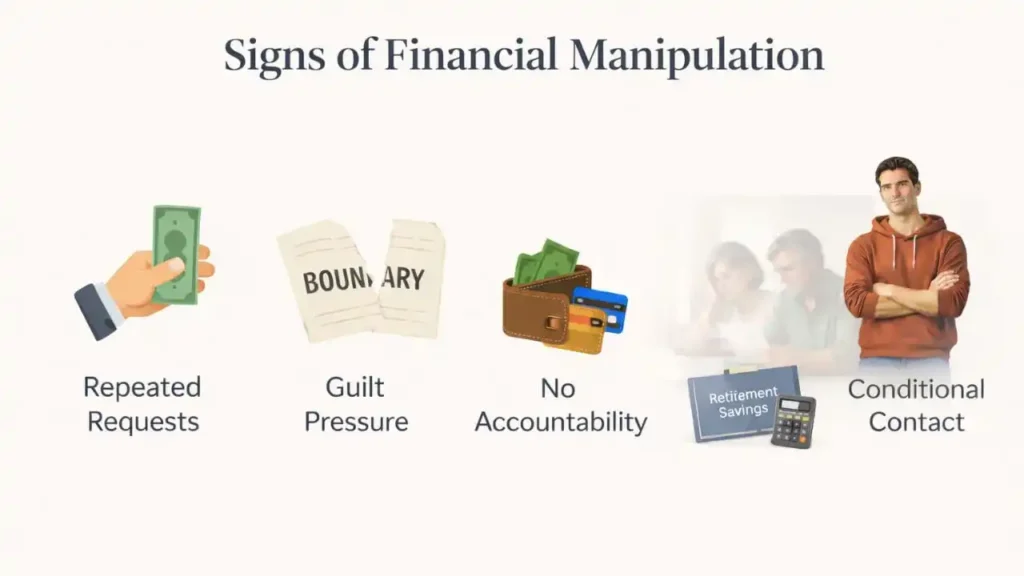
Do they make you feel guilty when you say no?
They make you feel guilty when you say no, is one of the key signs. They act rudely and are emotionally distant from you, rather than respecting your boundaries. You start to believe that you are a poor parent or that you have not done enough for your child. Actually, it’s your child who needs to know the limits in this situation.
Do they act like they have a right to your money?
If your child acts as if they have a right over your retirement savings and does not acknowledge your extra effort towards them, consider that you are a family and you must do this for them.
Do they have financial emergencies on a regular basis?
When every request is presented as urgent, and you don’t get time to think. They use emergency as an emotional trap because they know in this situation, you will respond out of fear rather than clarity. While a struggling child may experience difficulties from time to time, manipulation creates a pattern of persistent financial instability.
Repeated emergencies are often the result of practiced dependence.
Do they avoid accountability after you help them?
If they never show effort, time, resources, or responsibility towards your assistance, then it’s a kind of financial manipulation. In such a situation, parents often mistake silence for relief, and that’s where the problem starts. If you are supporting your child, then they must be held accountable for it; otherwise, you are promoting avoidance in them rather than development or a sense of responsibility.
Help without accountability becomes enabling.
Do they become angry when you ask questions?
A child who is in real need of support may explain their situation. But if they become defensive or react with irritation whenever you ask them where the money goes, then it’s a clear sign of financial manipulation towards parents. Respect and honesty are the two main pillars of any adult relationship.
Anger is often used as a way to protect or manipulate.
Do they blame you for their financial struggles?
Some adult children blame parents for their life struggles. They think their hardships are your fault and hold you accountable for your parenting, your decisions, and your responsibility towards them. As a result of this, you start giving them money out of self-doubt or guilt, not generosity. Even one of my clients has started giving more to reduce their guilt or to cover their child’s blame.
Do they threaten distance or rejection if you stop helping?
I’ve seen this in many of my clients’ cases, and this one is the most heartbreaking sign for parents and also a kind of both emotional and financial manipulation. If you notice your child has withdrawn from you and become more distant and less respectful when you stop giving them money, then you must pay attention to this.
Healthy relationships are never about money; if affection or contact decreases after you stop financial support to your adult child, then the connection was never about you; it was about what you were providing to them.
Do they pressure you into loans, credit cards, or co-signing?
Sometimes adult children ask parents to undertake financial risk on their behalf, like applying for a credit card, co-signing a loan, or registering anything in your name, but this might compromise your own retirement and security.
You may stay silent to avoid any conflict, or you just can’t say no to your child, but supporting your child should never come at the expense of your future or require you to take on debt that is not yours.
According to the Consumer Financial Protection Bureau, older adults are often targeted for financial manipulation by their trusted individuals.
Do you feel anxiety every time they call or message?
If you feel anxiety or experience tightness when their name pops up on your screen, then this is a signal your body recognizes, but your heart tries to ignore it out of love for your child, but love shouldn’t be an expression of worry.
Many parents ignore this emotional signal.
Do you give money but still feel emotionally empty afterward?
This is one of the deepest signs of financial manipulation. Because you don’t feel any affection or attachment even after you have helped them. Instead, you feel used or lonely; you start to feel like you have no value to them or just a source of money. At this point, most parents start to grieve even when their child is still alive.
Most Important Question that Parents Ask
Is my adult child using me or struggling for real?
Struggling adult children often show:
1) effort
2) openness
3) accountability
4) appreciation
Manipulative behavior often shows:
1) avoidance
2) entitlement
3) manipulation
4) lack of empathy
It isn’t always bad. Sometimes it’s learned dependence, fear, or irresponsibility. But the effect on you is still important, and you have to be careful.
What You Can Do Now
You may feel overwhelmed after reading these signs, but you are not helpless; in fact, you are the one who is independent. Take your time and respond with clarity and care.
Step 1: You Must Honestly Analyze the Pattern: You have to accept what has happened. You must admit, “This is no longer support; instead, this is financial dependence.”
Step 2: You Need to Set Simple Financial Rules: You can create rules like:
- I will not pay recurring bills.
- I will only not help with repeated emergencies.
- I will not give money without a plan.
Step 3: You Need to Separate Love From Money: You need to understand that your connections should value you, not your money. You can simply say to them, “I love you, but I will not fund this lifestyle.”
Step 4: You should encourage professional support.
Your adult child may need:
- Financial counseling
- Career coaching
- Therapy
Step 5: You Must Protect Your Own Financial Stability
You must save your:
- Retirement savings
- Emergency funds
- Medical needs
Because your security matters.
Step 6: You should be able to say no without explaining too much: You can simply respond with “I can’t help financially right now.” or “I can’t pay the bills or rent.”
Example from Daily Life:
Your adult child may ask for rent money; you can respond with, “I won’t pay for your rent, but I can help you with how you can manage your finances or help you to find better work options.”
Why does Common Advice Fail in this Situation?
Common advice usually fails in such a situation because it is about money and ignores the emotional bond that most parents want to save. I know, most of the time, the issue is not just financial; rather, it is emotional.
As a parent, you may worry that setting limits would cause a conflict in your relationship, or you may fear being seen as a selfish or unsupportive parent. Because of this fear, you may not want to risk your connection.
But when it comes at the expense of your own security, then you can’t ignore the issue, as this is not the solution; you need to pay attention before it gets too late.
Conclusion
If you recognize the signs your adult child is using you financially, then don’t get anxious or overwhelmed; take your time to process your emotions and accept what has happened, and decide what to do next with more clarity and better understanding.
If you feel constant fear, guilt, insecurity, or financial manipulation, then you must pay attention to it. Your support to them should not be the result of any fear of losing connection or any type of guilt; this should be out of love and respect, with proper boundaries on both sides. Helping your child should not require you to sacrifice your own security.
PEOPLE ALSO ASK FOR
Is It Wrong to Cut Off Financial Help?
No, it’s not wrong; in fact, you should think of it when your own security is at risk, or your adult child is getting dependent on you. Parents are not required to provide financial help throughout life, especially when the child has grown up.
Why Do I Feel So Guilty Saying No?
Because you think good parenting is endless giving or saying no, it may conflict with your identity as a parent. So, when you try to say no, your mind interprets this as you being a failure as a parent, and that causes the guilt.
My child is financially irresponsible
If your child is financially irresponsible, stop rescuing him again and again; let him face the consequences; this will develop a sense of responsibility in your child. His short-term stress can be reduced by your financial assistance, but this will make him dependent, which is harmful in the long run, and he will never be able to face the realities of life.
My grown child makes bad financial decisions.
If your child is bad at financial decisions, you can offer them guidance and encourage responsibility. Do not help them with money because your repeated help will enable the same pattern in them, and they will not feel the need to be more careful.
How to Stop Financially Supporting Your Adult Child?
Address the issue calmly, set clear boundaries. You can also stop the financial help in phases; do not stop the support all at once, give them a proper deadline, as this will prepare them for the time ahead.
What is Entitled Dependence Syndrome?
When an adult child becomes dependent on parents, both emotionally and financially, they start to believe that they need constant support throughtout the life. Instead of acknowledging your extra efforts towards them, they think of it as their right, start to resist responsibility, and react with anger or guilt tactics when you set limits with them.
