When and How to Stop Financial Support to Adult Children and Protect Your Peace?
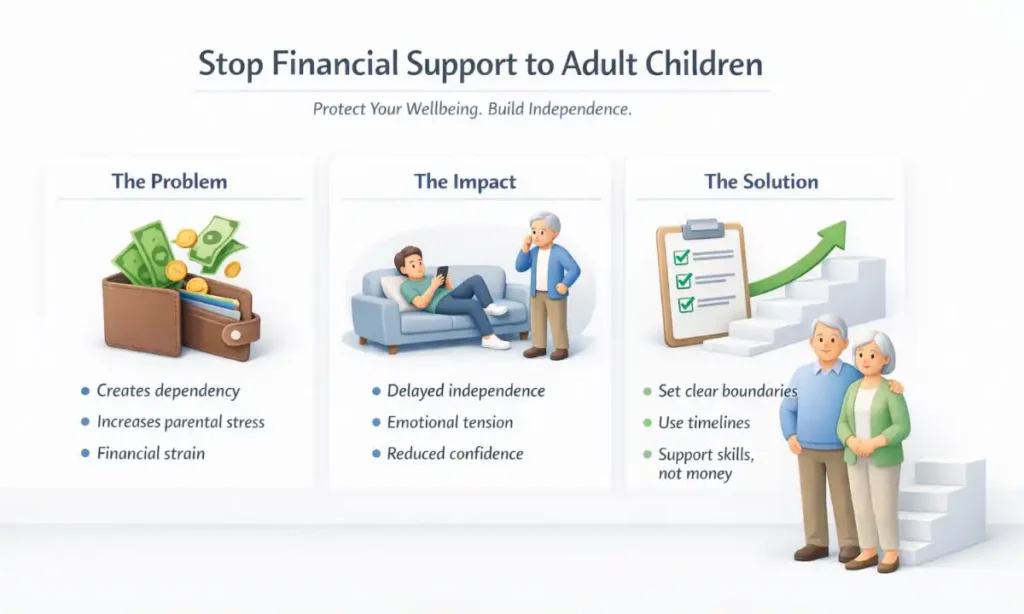
I’m going to talk about something that a lot of you are quietly dealing with today. You may be among parents who might continue to provide financial support for children. Here I am not talking about kids but the adult ones; if so, then you should now start thinking about “How to Gradually Stop Financial Support to Adult Children.”
A study says 79% of parents are helping their children financially by paying their bills, their groceries, academic fees, and rent, but the question arises for how long you can do this or at what cost.
According to another report, parents are spending twice as much on their adult children as the amount they are putting towards their retirement, which can become a burden for them in their older age.
Table of Contents
Why do parents provide financial support for adult children?
The high cost of living in recent times has made many parents jump in to provide financial support for adult children, because as a parent, it is difficult for you to see your loved one in a financial crisis, but this comes with a great cost. A study says 50% of parents who support their adult children are sacrificing their savings or retirement plans.
J.P. Morgan, author of Your Best Financial Life, states, Parents who struggled in their younger years may want to spare their children the same financial pain. Those who were better off might want to provide the comforts they enjoyed to offspring who otherwise “might not be able to afford a nice house in the suburbs and have access to a nice car.”
Some questions to ask yourself
Is your Child making an Effort towards Self-Sufficiency?
If your children are working towards financial independence or making efforts to manage finances on their own, like if they are currently paying for their bills, academic fees, or loans, but finding it difficult to make ends meet, then in this situation, you can provide financial support for adult children to reduce their burden.
On the other hand, if they are just depending on you for their finances, then you should think about it again. Ask them to find a job or work regularly; otherwise, you will make them more dependent on you, and this will go on throughout life, and they will never be able to learn self-sufficiency.
Are you compromising your own Security or boundaries?
I have personally witnessed many parents supporting their child at the expense of compromising their own boundaries, which eventually hurts them later on and makes their child more exposed to the hardships of life.
Before you become a parent, a mother, or a father, you are a separate individual with your own physical, emotional, and financial needs. As an individual, you must see if providing financial support for adult children is causing damage to your personal boundaries or harming your financial situation.
If so, then it’s a great question for your future: what will you do in later stages of life? Will you have the same energy to do work as you have now?
Another issue is, if you continue to provide financial support for adult children, then your child may develop a high level of dependence on you; knowing that you will pull them out of a crisis can make them lazy and irresponsible towards life.
Research from the University of Minnesota (2019) says that prolonged financial support from parents causes lower self-efficacy in children till adulthood.
Are your Children Expecting you to be their Financial Support System?
As a parent, you should not only provide financial support for adult children but also keep a check on their personality traits they may have developed a receiver’s attitude. Financial support encourages dependence in a person and makes them a receiver who doesn’t want to leave their comfort zone.
When a person is dependent on someone, they start expecting to receive everything from the supporting hand or may believe that it’s the supporter’s duty to provide for them instead of acknowledging it, which becomes a real problem, because the recipient develops the attitude of taking without any limitations, they like to stay in their comfort zone, and they will start to avoid the reality. It’s totally up to you; you have to figure out when to say, “Enough is enough.”
Avoid Financial Dependency in Adult Children
If you are a parent providing financial support for adult child, or just thinking of helping them, here are some strategies to prevent dependency in them.

Set Clear Boundaries with Timeline
As a parent, you must define boundaries with a clear timeline. Be realistic about what you can pay for and what you can’t; Explain clearly how long you can pay for them, be clear on whether you will help them with loans or not, ask about their plans for academic fees, and tell them straight that they should bear their personal expenses or groceries on their own.
Set up the deadline for everything with their mutual consent so that they will take it seriously; otherwise, they will think of it just as vague statements.
Held them Accountable
If you are providing financial support to your adult child, then they should be held accountable for it. Ask them questions about their source of income, spending, and savings. This will develop a sense of responsibility towards their actions and will also lessen their dependence on you.
Promote Financial Literacy from a Young Age
Train your kids from a young age on how to handle their finances, like you can teach them on how to manage their pocket money. Then, as your children grow, teach them to create a budget and how to stick to the budget by spending and saving money responsibly. For this you can start with books on personal finances and introduce them to budget managing apps.
Encourage Independence
Ask them to join some internship programs or work part-time to earn enough to cover their own needs. Let them decide how much to spend and how much to save. Don’t try to pull them out of crisis every time; let them bear the consequences, as this will teach them risk-taking.
How to Stop Financial Support to Adult Children? 5 Steps to Consider
If you are already providing financial support for adult children, then here are some suggestions for you on how to Stop Financial Support to Adult Children with a strategy that should be safe for you and your child.
Analyze the current situation
Start by analyzing the current financial situation of both you and your child, assess how much support you can provide them, and determine for how long you can maintain it. If you are providing financial support for adult children from your savings, then you must consider its impact on your future.
Understand their finances and spending and figure out the reasons why you should help them, keeping in view the financial security of you and your child.
Start a conversation
If you are planning to stop financial support to adult children, talk to your child openly and make it a gradual process. Tell them about your financial shortcomings or any other reasons you have, and ask about their concerns, as this should be a mutual decision, not just one-sided.
It can disturb your relationship with your child. Be ready before having this conversation, prepare yourself emotionally and mentally, because this won’t be an easy one.
Set a Plan
Create a plan with your child and your shared concerns on how you are going to slowly reduce and then eventually stop the financial support. The plan must contain deadlines because this will make your child more aware and responsible, and will encourage them to work according to the plan.
Don’t rush through it; give them time to adapt to these changes, as this is definitely going to be difficult for them.
Review your Plan
Take a regular review of your plan; if things are working as they were decided, check your child’s progress over it to see if they are working according to the plan or just giving you lame excuses. Always be open to any unexpected hurdles or changes you may need to make in your plan.
Be with them emotionally
As a parent, you should always be your child’s emotional support, even if you are stepping back from the financial support you were providing them. Your child may suffer both emotionally and psychologically because of the crisis; give them time to overcome and be with them emotionally.
Make them believe that things will improve with time, or they may find a way out. Make them believe in themselves and also encourage them to take complete charge of their lives as adults.
Do not Feel Guilty
Most often, parents find themselves guilty for thinking about their own financial security and not providing financial support for adult children. Then listen, you just don’t need to be; you have already done what’s in your capacity, and it’s not your responsibility to provide for them throughout their life. They are grown-ups and should take their life responsibilities into their own hands.
You may retire soon or may have already retired, so this is the high time for you to think about yourself first, because you are entering into the phase of your life where you will not have the same energy to carry out your life and will require your stored resources, especially the financial ones.
On the other hand, your children still have the power and time to build for themselves. So, taking care of yourself first is not something to be guilty of.

Conclusion
If you are willing to provide financial support for adult children, then you must have some valid reasons to continue your support, but if there is no obvious reason, then you should think about how to stop financial support to adult children; otherwise, you will develop dependency in them, which is not going to be good for either you or your child’s future.
In order to avoid this dependency and make your child responsible, you have to take some careful steps. Start by analyzing the current financial situation of you and your child, and have an open discussion with them.
Formulate a plan on how to slowly reduce and then finally stop the support, and decide on the deadlines mutually, as this will make them more aware and responsible.
Be patient all this time, encourage your child to increase their income streams, and be emotionally present for them, as this time is going to be very challenging for them.
Does supporting adult children financially affect parents’ mental health?
Long-term financial support for adult children can affect the parents’ mental well-being. Especially if support is continued without proper planning or boundaries, it will become a burden for older parents and will exhaust them both mentally and physically.
Why do parents feel guilty about stopping financial support for adult children?
Most often, the caregiving and emotional support continue into older age. So, when it comes to stopping financial support, parents find themselves guilty of not providing enough support, or they may fear for the future of their child and start judging their parenting. At this point, all they need to understand is that financial support does not equal love.
How can parents set financial boundaries without harming mental health?
Parents can protect mental health by setting clear financial limits, such as a timeline and deadlines. Setting up clear goals, like how much and for how long the sustenance will be provided. Everything should be figured out through clear communication and formulation of the proper plan.
Does financial dependency affect adult children’s emotional development?
Yes, prolonged financial support can increase avoidant behavior and make the adults dependent, irresponsible, less aware of life, and low in self-confidence. While independence makes a person resilient and confident.
Can stopping financial support disturb family relationships?
If boundaries and expectations are not properly met, then stopping financial support can cause damage to family relations. Parents and children both should try to understand each other’s circumstances and shortcomings in a respectful way, maintaining healthier adult-to-adult relations in a family.